Friday, July 25, 2014

Food safety Chinese style

China probes food businesses; Hong Kong bans imports in meat safety scare | Reuters:

"China's food regulator has visited close to 600 restaurants, businesses and food distributors as it investigates a fast-spreading food safety scare that has dragged in a number of global brands and hit food outlets as far away as Japan. 
Hong Kong said on Thursday it suspended, with immediate effect, all imports from the U.S.-owned Chinese supplier at the center of the latest scare. It was unclear when the company last shipped its products to Hong Kong. 
Shanghai police detained five people on Wednesday, including the head and the quality chief of Shanghai Husi Food, a supplier to foreign fast-food brands including KFC, McDonald's Corp and coffee chain Starbucks Corp over allegations it supplied out-of-date meat. 
Shanghai Husi Food is owned by Illinois-based OSI Group. \ 
Yum Brands Inc, the owner of KFC and Pizza Hut, severed ties with OSI, and McDonald's said it would move supply from the Shanghai facility to OSI's new plant in the eastern central province of Henan.

"


'via Blog this'

Catering for single diners

BBC News - Tables for one - the rise of solo dining:

"Not too long ago solo dining was synonymous with a greasy takeaway scoffed down in the car, or room service consumed in the sterile anonymity of your hotel room. This was preferable to the thought of dining alone in a proper restaurant, and the associated stigma of being seen as a "friendless loser".

Some of that sense of unease surrounding booking a table for one no doubt dates back to our childhoods, when sitting alone in the high school cafeteria was tantamount to social suicide. Yet today, a growing number of us live alone - including one out of every seven adults in the US - so the stigma surrounding solo dining has started to dissipate, says Aaron Allen, a Florida-based global restaurant consultant.

With more and more people choosing to dine out alone, Mr Allen says savvy restaurants around the world are trying to make themselves more welcoming to solo diners, for example by fitting more bar seating, or encouraging waiting staff to be more attentive to customers sitting on their own." ...
At the San Diego restaurant Top of the Market, executive chef Ivan Flowers was brought in last year to make some changes, with one main aim being to increase the number of people dining alone.

He felt that while the eatery already had bar seating in front of the open kitchen, it was underutilised because the chefs weren't interacting enough with the customers.

Mr Flowers says solo diners sitting by the kitchen now get "to see a show", which includes cooking demos, free tastings and conversations with the chefs.

"If you catch our eye, we'll ask, 'Would you like to try that?'

The Eater website gets it right

Here's What Every Trendy Restaurant Menu Looks Like - Eater IDK - Eater National:

(Click to enlarge)


'via Blog this'

The Tour de France is an epic marathon of eating.

The Epic 2,200-Mile Tour De France Is Also A Test Of Epic Eating : The Salt : NPR:
The cyclists now competing in the 101st rendition of the race are burning an average of 700 calories per hour while riding and, to keep their weight up and maintain their health through the three-week event, they must eat 6,000 to 9,000 calories every day.
... The almost nonstop eating begins with juice as soon as the athletes wake, according to Nigel Mitchell, head of nutrition forTeam Sky. After joining their teammates in the hotel dining room, they devour a massive buffet-style breakfast, heavy on carbs and sugar, and moderate in fiber, which can add unwanted bulk to the cyclists' bellies.
When they've finished this matinal meal, they pile into a bus, and keep eating, taking in hundreds more calories in energy drinks and bars before arriving at the starting line. Once they begin pedaling, team support vehicles shadow the riders, and assistants hand them energy gel packets, homemade rice cakes and Panini sandwiches.
'via Blog this'

Thursday, July 24, 2014

The Mexican food boom

Chart: Americans can’t stop eating Chipotle’s burritos - The Washington Post:


There are few things as smooth as Chipotle's ability to sell more and more burritos seemingly each day, week and month, but certainly each quarter and every year.

The Mexican fast food chain, which now slings billions of dollars in burritos (and burrito bowls) each year, saw its second quarter sales jump by 29 percent compared to the same period last year.

Chipotle's performance didn't merely beat analyst estimates — it crushed them. The chain was forced to raise its prices earlier this year, after rising food costs swallowed a hefty chunk of the company's profits. The expectation was that it would have a negative impact on store traffic, but instead same-store sales — sales at Chipotle restaurants open for at least 13 months — jumped by 18 percent.

'via Blog this'

Friday, July 18, 2014

The glories of bone marrow from a Singapore street stall

Along with his description of a delicious meal, Konstantin Kakaes explores just where bone marrow's flavour comes from. From Guy Crosby, an adjunct professor of nutrition at Harvard and the science editor of America's Test Kitchen, he discovers that the many nucleotides present in bone marrow amplify the umami taste of glutamate by as much as 20 to 30 times. "Crosby reminded me that the function of bone marrow is to produce red blood cells. Because it is, in effect, a factory for the creation of cells, Crosby says, bone marrow is like an egg: 'a perfect food. It's got everything in it needed to create and sustain life'."

Not So Offal: Why Bone Soup, A 'Perfect Food,' Tastes So Meaty : The Salt : NPR:


I ate the best meat I've ever eaten through a straw.
When the Singaporean food stall proprietor who'd just served me a plate of bones first offered the straw, I refused. I didn't want to take any shortcuts as I worked the tastiest bits of marrow out from the skeletal hollows.
But a couple of minutes into my repast, my face smeared with the viscous broth the bones had come in, I couldn't face the thought of leaving some of this food unexploited. So I took the proffered straw, inserted it down into a bone cavity and inhaled.
It tasted like the first bite of an excellent steak, only more so. Unlike biting into a rib-eye, when that initial sensation gives way to something less exultant and chewier, the marrow lingered on the tongue. I felt as if I was mainlining glutamate, the substance responsible for umami.
These bones had been cooked for hours in a fluorescent red amalgam of tomato and chili.Sup tulang, as this dish is called in Singapore, is Malay for "bone soup." I ate it at Deen Tulang Specialist, one of a handful of stalls specializing in the dish in the Golden Mile Food Centre, one of many food courts, known as hawker centers, in Singapore.
'via Blog this'

Wednesday, July 16, 2014

A sign of the decline in French cuisine

BBC News - The new sign on French menus:


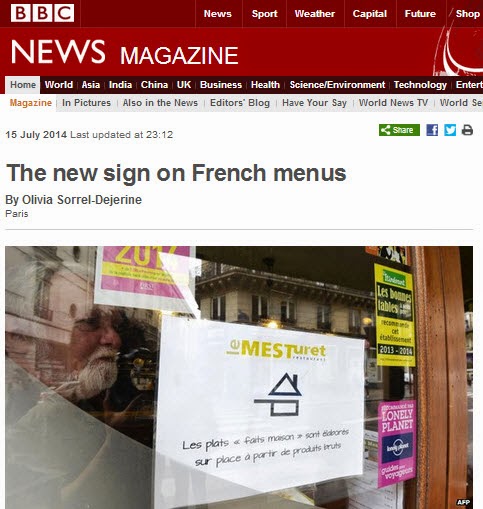
"The summer rush to France - a magnet for more foreign tourists than any other country - is about to begin. And this year travellers may spot a new logo on menus, designed to flag up when food has been home-made. But how exactly is "home-made" defined?
 The bad news is that - just like anywhere else in the developed world - many French restaurants just reheat pre-prepared food, rather than cooking it from scratch.

French consumers estimated, in a poll last October, that barely half of restaurant meals were home-made, while the Union of Hotel Skills and Industries suggests that 85% of restaurants secretly make use of frozen or vacuum-packed food.
In the country of Parmentier, Escoffier, and Paul Bocuse, to many people this just doesn't seem right, so a law designed to uphold French culinary traditions was passed earlier this year, and came into force this week.

Now any restaurant that serves a home-made dish can indicate it on the menu with it new logo - in the shape of a saucepan with a roof-like lid.
From next January it will be compulsory for all menus to carry the logo - so if you don't see it, the food is not fait maison.

"We chose to represent 'home-made' with a logo so that foreign tourists could understand it," says a government spokeswoman.

"French gastronomy represents 13.5% of foreign tourists' expenses and it's undeniable that if we add value to the quality of our restaurants, it will have an impact on tourism.""


'via Blog this'